
Learning intention: students will examine how biological, psychological and social factors influence and are influenced by pain
Success Criteria: students will be able to
- Describe the biopsychosocial model of pain
- Identify biopsychosocial factors and how this could impact a person’s pain experience
- With consideration of biopsychosocial factors, describe how pain can impact a person’s life
- Describe stigma and how it affects people with chronic pain
Biopsychosocial Model
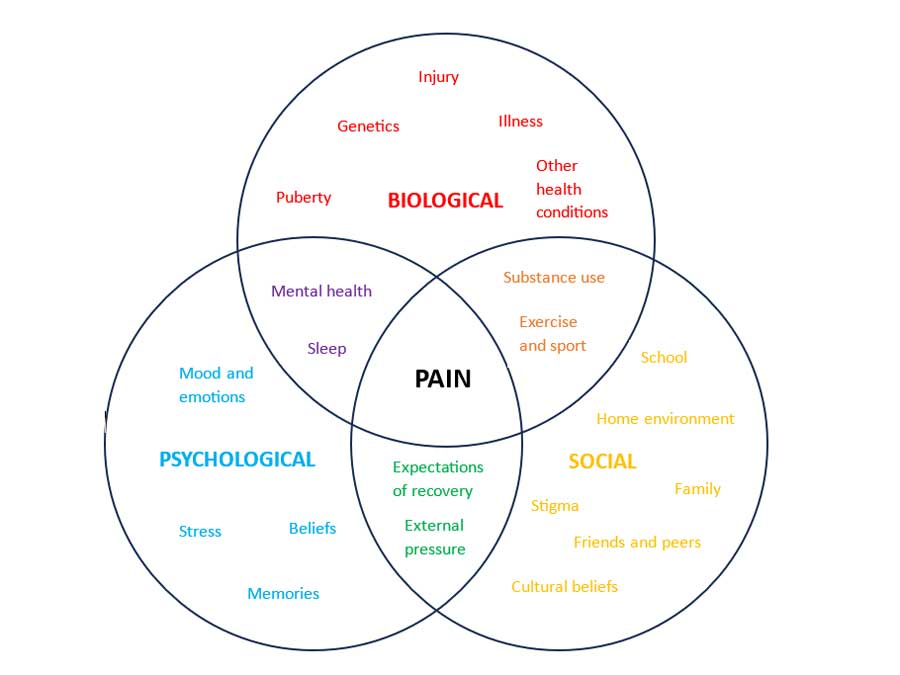
The biopsychosocial model describes the relationship between biological, psychological, and social factors affecting health. This model adopts a holistic perspective on health, viewing it as a dynamic, personal, and complex phenomenon shaped by numerous internal and external factors.
Wellbeing is a person’s overall sense of wellness in physical, mental, emotional, and social dimensions. This holistic focus emphasises the interconnectedness of all these dimensions affecting a person’s health and happiness. In this sense, the biopsychosocial model can be another lens with which to understand wellbeing.
How does pain fit into the biopsychosocial model?
We used to think of pain as a purely biological phenomenon; that pain indicates tissue damage or injury. As we discussed last lesson, we now know this isn’t true. Pain can be understood using the biopsychosocial model.
Research has linked pain in teenagers with:
- Lower levels of physical activity and sports participation
- Obesity
- Poorer mental health
- Substance use (smoking, drugs and alcohol)
- School absence
- Poorer performance at school
- Bullying
The relationship between these factors and pain can be understood using the biopsychosocial model. When understanding someone’s pain experience, we must consider the whole person.
It is important to note that the relationship goes both ways; for example, living with chronic pain can make someone feel depressed, and having depression can increase suffering due to chronic pain.
Examples of biological, psychological, and social factors influencing pain are:
How do biopsychosocial factors affect pain after an injury?
Malik is 17 years old and a very good rugby player. He exercises every day, goes to rugby training 3 times a week, and plays a game every Saturday. One day at training, he was dodging a tackle when he fell over and hurt his ankle. Malik was in a lot of pain and couldn’t walk properly, so he went to see his local doctor who did a physical assessment of Malik’s ankle and ordered an x-ray. Luckily, the x-ray showed his ankle wasn’t broken. The doctor said Malik had sprained his ankle and reassured him he would be back to training within 6 weeks.
But Malik wasn’t reassured. He had been training to get into the state representative team for rugby. Malik wanted to get a sports scholarship to go to university in another city, so felt it was important to make the team. Malik had sprained his ankle previously, and he remembered how long it took to rehabilitate it properly. If Malik couldn’t train properly for 6 weeks, he thought this could really affect his chances of getting into the team. Additionally, Malik was stressed about his upcoming school exams, and he felt pressure from his family to do well at school. Malik uses exercise and rugby as an outlet to manage his stress, but he felt his ankle injury prevented him from exercising properly.
Identify the biological, psychological and social factors affecting Malik’s pain experience:
Examples:
- Biological: sprained ankle, previous injury, physically active (probably strong and fit), growth changes
- Psychological: stress, worrying thoughts, memory of previous injury
- Social: rugby performance, family, school, financial pressures,
Even though a sprained ankle is usually a minor injury with a good expected outcome, it is a much bigger issue for Malik because of the impact of biopsychosocial factors.
How could these factors impact Malik’s recovery?
Examples:
- Go back to sport too early and not rehabilitate properly
- His previous ankle injury could make it harder to rehabilitate, take longer, and/or increase the risk of re-injuring
- Impact his mental health and sleep, which could delay recovery
- Stress could make him unwell, which could delay recovery
- Lose fitness from not exercising, which could delay return to sport
Malik’s friend, Sophia, also sprained her ankle. Sophia was running for the bus when she tripped over and hurt her ankle. Whilst it was painful and inconvenient for Sophia, she wasn’t too concerned. Sophia lived close to the school, so her dad was able to drive her instead of catching the bus. Her sore ankle meant she couldn’t participate in school sport, which Sophia was quite happy about because she didn’t enjoy it. Sophia loved playing the violin and reading, so resting her sprained ankle gave her more time to do the things she enjoyed.
Even though Malik and Sophia have the same injury, biopsychosocial factors mean they have very different experiences. This also means they may have different outcomes.
How do biopsychosocial factors affect pain when there isn’t an injury?
As we discussed last lesson, pain can exist when there is no injury, or after the injury has healed.
Jasmine is 14 years old and suffers from stomach pain. The pain is constantly there and is sometimes so severe that she can’t go to school. On average, Jasmine misses out on school once a week. She often feels she is behind on her schoolwork and misses playing sports like she used to. Jasmine feels sick most days and she avoids eating because this can make her pain worse. Jasmine used to love cooking, but she doesn’t do this anymore because it reminds her of her stomach pain.
The stomach pain started about a year ago, but Jasmine can’t remember how it started. Things were stressful at home last year because her parents were getting a divorce. Jasmine found this particularly difficult because she didn’t have any siblings to talk to about it and she had to move houses. She has suffered from anxiety since she was a child, and the change in her home environment made her anxiety more difficult to manage.
Jasmine has lots of medical investigations and appointments to diagnose the cause of her stomach pain. She finds the appointments stressful because the doctors still can’t find a cause of her pain and this makes her feel like the pain is never going to go away.
Her parents and teachers think she is using the pain as an excuse to miss out on school, and she sometimes hears her friends whispering about her in the playground. This makes her want to avoid going to school altogether. She feels people don’t believe her.
Identify the biological, psychological and social factors affecting Jasmine’s pain experience:
Examples:
- Biological: stomach pain, nausea, loss of appetite, reduced activity/ sport
- Psychological: anxiety, expectations of recovery (won’t get better), stress
- Social: stressful life events, change in home environment, missing out on school and sports, bullying and social isolation, not feeling believed, avoiding hobbies, lots of medical appointments, bullying
Considering these biopsychosocial factors, how could pain impact Jasmine’s life?
Examples:
- Impact relationships with family and friends
- Lead to social isolation
- Bullying at school
- Affect school attendance and performance
- Worsen her anxiety
- Lose enjoyment in hobbies
- Cause weight loss
- Impact her nutrition
- Lose strength and fitness
- Lose trust in health professionals
Sometimes, people may experience pain in response to stressful life events or changes in their mood. Even if there isn’t a biological“cause” for their pain, the pain is still very real and can be very disabling.
Unfortunately, a lot of people don’t understand this and may think people experiencing chronic pain are “faking it”. This is not true and is an example of stigma.
How does stigma affect chronic pain?
Stigma refers to negative thoughts or unfair beliefs society or a group of people have toward a particular issue. Chronic pain is often referred to as ‘an invisible condition’, because unlike a broken leg in a cast, you can’t see pain. Another way to think about chronic pain is as an iceberg- where only 10% of the problem is visible, but the remaining 90% – the suffering and impacts- can’t be seen from the outside.
A lot of people also hold the false beliefs about pain. Because chronic pain is largely misunderstood, people with chronic pain may experience stigma from their family and friends, teachers, colleagues, or employers, and even from health professionals.
Stigma can affect people with chronic pain in many ways:
- Social isolation
- Avoiding spending time with family and friends
- Avoiding going to school or work
- Avoiding sports and hobbies
- Avoid leaving the house altogether
- Not wanting to seek medical help
- Reinforce negative feelings about themselves
- Increase stress levels and worsen mental health
- Increasing the pain itself
We can reduce the stigma of chronic pain by learning more about pain, talking more about pain and understanding how to manage pain. We will discuss this in the next lesson.