We are excited to share our new publication in BMC Pediatrics.
In this study, we explored adolescents’ understanding of pain and their preferences for learning about pain in school. The findings will directly inform the development of a school‑based pain education module that reflects what young people need and want to learn, and how they prefer to learn it.
We hope you enjoy it, and please feel free to contact us if you’d like to discuss the findings or future directions.
Adolescents’ understanding of pain and their preferences for learning about pain at school: A cross‑sectional survey
Pain is highly prevalent in adolescence and can have lasting physical, psychological, and social impacts. Despite this, there are no well‑resourced public health initiatives that provide adolescents with evidence‑based pain education. Delivering pain education in schools offers an opportunity to reach all young people, but to be effective, education programs must align with adolescents’ existing knowledge and learning preferences.
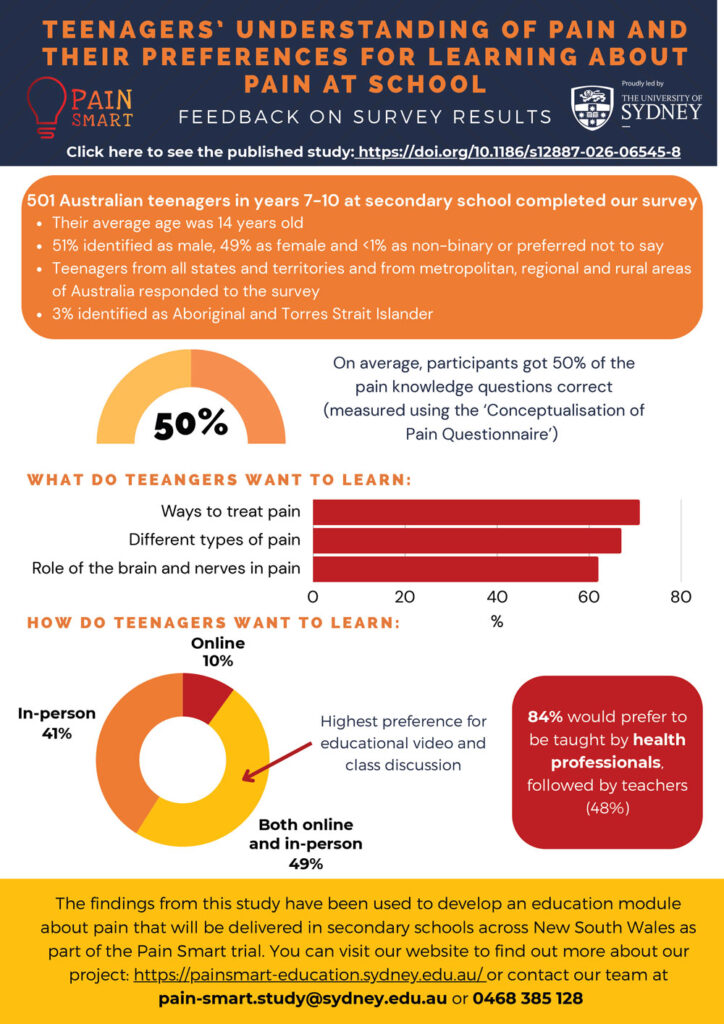
We conducted a national online survey of 501 Australian adolescents aged 11–16 years (Grades 7–10) to examine:
- Adolescents’ understanding of pain
- What content they want to learn about pain
- How they prefer pain education to be delivered in school
Key findings included:
- Adolescents answered only about half of pain knowledge questions correctly, highlighting important misconceptions about pain and injury.
The most preferred pain education topics were:
- Ways to treat pain (70.5%)
- Different types of pain (67.1%)
- The role of the brain and nerves in pain (62.1%)
Most adolescents preferred pain education to be delivered by health professionals, followed by teachers.
Nearly half preferred a combination of online and face‑to‑face learning, with the strongest preference for watching an educational video followed by class discussion.
Overall, our findings show that adolescents’ understanding of pain does not always align with contemporary pain science. School‑based pain education should address these misconceptions and be designed around adolescents’ preferences, using interactive and blended learning approaches to maximise engagement and impact.
Citation:
Bogard I, Kamper SJ, Montgomery LRC, Williams CM, Nascimento Leite M, Gorringe J, Gordon G, Yamato TP. Adolescents’ understanding of pain and their preferences for learning about pain at school: a cross‑sectional survey. BMC Pediatrics. 2026;26:133. https://doi.org/10.1186/s12887-026-06545-8